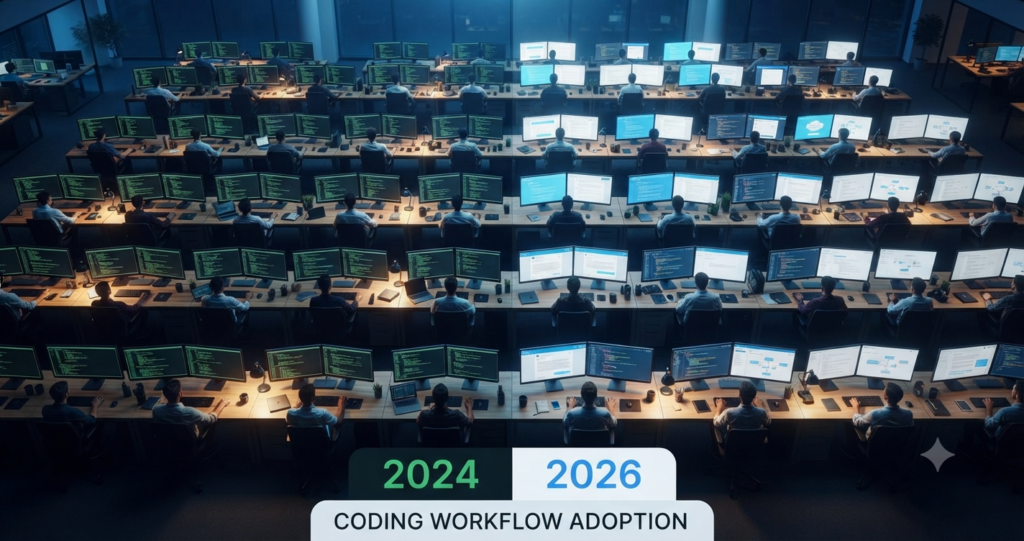
Developers, CEOs, teachers, kids — everyone’s heard the phrase “AI writes code now.” But is it actually true? Is it a big deal? And what does it mean for the world? Here’s the real story, explained simply.
Two years ago that number was close to zero. Here’s how we got here — and what it actually means.

A few years ago, if you asked a computer to write software for you, it would stare back blankly. Computers are great at following instructions — but writing the instructions themselves? That was firmly a human job.
That changed fast. Modern AI systems — the same kind of technology behind chatbots you might have used — turned out to be surprisingly good at understanding and writing code. Not just copying snippets from the internet, but actually reasoning about what code should do and generating it from scratch based on a plain English description.
Imagine you could tell your computer: “Build me a button that turns red when someone clicks it and sends me an email.” Instead of you spending an hour looking up how to do that, an AI coding tool writes the necessary code in about 10 seconds. That’s the basic idea.
The wild part? It works. Not perfectly, not always — but well enough that 92% of professional developers now use these tools every single day.
The term “AI coding” covers a wide range of tools: some that whisper suggestions as you type (like autocomplete on steroids), some that chat with you about what to build, and some — like Claude Code — that actually go into your files and make changes themselves. They’re all part of the same wave.
The AI coding boom didn’t happen overnight. It’s the result of a few things coming together at the same time — like a perfect storm of technology, money, and timing.
-
1Large Language Models Got Really Good at CodeThe same AI breakthroughs that made chatbots surprisingly intelligent also made them surprisingly good at understanding programming languages. It turns out code and human language have a lot in common — both have grammar, patterns, and logic. Once AI could handle one, the other came along for the ride.
-
2GitHub Copilot Proved It Was Useful in 2022Microsoft and GitHub released Copilot in 2022 and it was the first tool most developers ever tried that actually helped. It wasn’t perfect, but it was good enough to save real time. That cracked open the door — and every company with AI ambitions rushed through it.
-
3Competition Made Everything Better, FasterOnce one company proved there was a market, dozens more piled in. Cursor, Claude Code, Gemini, Codex, Windsurf — each one pushed the others to improve. In two years, the tools went from “kind of helpful” to “genuinely transformative for complex tasks.”
-
4The Context Window Got EnormousEarly AI tools could only “see” a small chunk of code at once — like reading one page of a book and trying to understand the whole story. By 2026, tools like Claude Code can hold your entire project in memory at once — millions of words of code. That changed what was actually possible.
-
5Developers Talked About It ConstantlyNothing spreads a developer tool faster than developers telling other developers about it. Reddit, YouTube, LinkedIn, X — the AI coding conversation exploded. By early 2026, it was impossible to be a working developer and not at least try one of these tools.
The AI Coding Boom — 2022 to 2026
Copilot
ChatGPT coding
10× context
Claude Code · $1B
92% adoption ↑
% of all code that is AI-generated · Alarming growth rate in the final year
Here’s where it gets interesting. The marketing says: developers are 55% more productive with AI tools. The independent research says: it depends — a lot.
The honest answer is: AI coding tools work, but not like magic. They’re powerful for specific types of work, still require human oversight, and the best results come from developers who understand what they’re looking at — not from people who just hit “accept” on everything the AI produces.
Of all the AI coding tools that exploded onto the scene, Claude Code became the one developers talked about the most. Not because it was first — GitHub Copilot got there years earlier — but because it went further than anything else available.
Most AI coding tools work like a very smart autocomplete: they suggest the next line, or answer a question when you ask. Claude Code does something different. It’s what’s called an “agentic” tool — it takes a goal you describe in plain English and executes it across your entire project, touching dozens of files, running tests, fixing errors, and reporting back.
- You ask a question, it gives an answer
- You copy the answer into your code yourself
- It sees one or two files at a time
- It can’t run or test what it writes
- You manage every step of the process
- Great for quick lookups and suggestions
- You describe a goal, it figures out the steps
- It directly edits your actual files
- It reads your entire project at once
- It runs your tests and fixes failures itself
- It manages the process, you review the result
- Handles complex, multi-step engineering tasks
The result: 46% of professional developers named Claude Code their most loved AI tool in 2026 — more than double the next competitor. It launched in May 2025 and hit $1 billion in annual revenue in 6 months. For context, most software companies spend years to reach that milestone.
Sometimes numbers tell a story better than words. Here are the ones worth knowing:
The Trust Gap — AI Coding’s Defining Challenge in 2026
Only 29% of developers trust AI-generated code without reviewing it — despite 92% using AI tools daily
Only 29% of developers actually trust AI-generated code without reviewing it. 96% say they don’t fully trust that AI output is correct. Half of all developers don’t always check AI code before it goes into their product — and studies show those projects end up with significantly more bugs.
The tools are powerful. The humans still need to be in charge.
The question everyone’s actually thinking about: are AI tools going to replace developers?
The data says: not yet — and probably not in the way people imagine. What’s happening is more nuanced, and honestly more interesting than a simple “AI takes the jobs” story.
| What AI Is Taking Over | What Humans Still Do Better |
|---|---|
| Writing repetitive, boilerplate code | Deciding what to build and why |
| Fixing known categories of bugs | Understanding what users actually need |
| Writing documentation and tests | System design and architecture |
| Translating specs into working code | Making judgment calls under uncertainty |
| Scanning for security vulnerabilities | Taking responsibility for what ships |
| Explaining what existing code does | Knowing when the AI is confidently wrong |
The pattern that’s emerging in 2026: fewer junior developers doing repetitive tasks, more senior developers doing higher-level thinking — and overall, software getting built faster with smaller teams. That doesn’t mean no jobs. It means different jobs, and different skills matter.
The developers thriving in 2026 aren’t necessarily the best typists or the ones who memorize the most syntax. They’re the ones who can clearly describe what they want, evaluate what the AI produces, catch mistakes, make architectural decisions, and understand their users. Thinking skills over typing skills.
You might be wondering: okay, this is interesting, but I’m not a developer. Why should I care?
Fair question. Here’s the honest answer: almost everything in your daily life runs on software. The apps on your phone, the websites you use, the systems your bank runs on, the software in your car. When the people building those things can work faster and fix problems more reliably, the stuff you use every day gets better.
- Apps update faster with fewer crashes because bugs are caught and fixed more quickly
- Smaller companies can build things that once required huge teams — meaning more choices for you
- Security vulnerabilities get spotted earlier, which protects your data
- New features that companies used to put off for years can ship in months
- The cost of building software comes down — which eventually shows up in prices and access
There’s also a bigger shift: the line between “people who can build software” and “people who can’t” is getting blurry. Someone with a great idea and basic technical knowledge can now use tools like Claude Code to build something they never could have made alone. That’s a genuinely new thing in the world.
The AI coding boom is real, it’s significant, and it’s moving faster than almost any technology shift in software history. 92% of developers use these tools. 41% of all code is AI-generated. Claude Code went from zero to $1 billion in six months. These aren’t hype numbers — they’re verified survey data from tens of thousands of developers.
But the story isn’t “AI replaced developers.” The story is: developers who use AI well are outperforming developers who don’t — and the gap is widening every month. The tools work. They require human oversight to work well. And the people who understand both the capability and the limits are the ones getting the most out of 2026’s most interesting technological shift.
Whether you code or not, this wave is reshaping the software that runs your daily life. Now you know why everyone’s talking about it.
What surprised you most in this article? Leave a comment — the best discussions happen below.