Every month you delay costs you more than you think. Waiting just one year to start saving $200/month could cost you over $15,000 in lost compound interest over 20 years.
Today — in just 10 minutes — you can change the entire trajectory of your 2026.
Managing money in 2026 isn’t optional anymore. With inflation still squeezing everyday budgets, a shifting job market, and the average American carrying $6,329 in credit card debt, financial literacy has become the most important life skill you can develop right now.
The good news? You don’t need a finance degree. You just need the right habits — and a plan.
Here are 10 proven money tips that can help you save more, eliminate debt, and start building real wealth — no matter where you’re starting from.
💰 1. Build Your Budget Around the 50/30/20 Rule
The single most effective budgeting framework for most Americans:
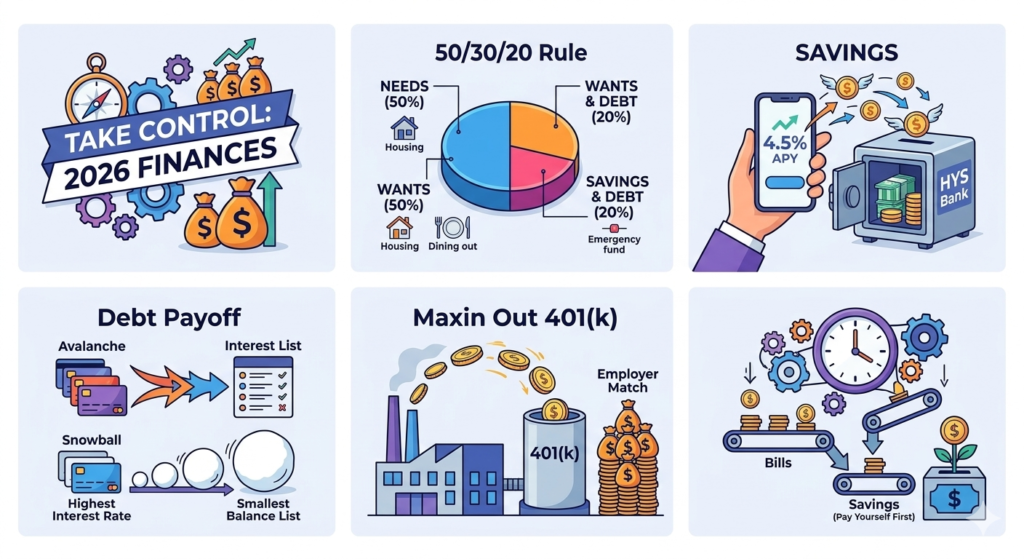
| Category | Percentage | Examples |
|---|---|---|
| Needs | 50% | Rent, groceries, utilities |
| Wants | 30% | Dining out, Netflix, shopping |
| Savings & Debt | 20% | Emergency fund, credit cards |
📊 [Insert 50/30/20 pie chart image here]
Best free budgeting apps in 2026: YNAB · Monarch Money · PocketGuard
🏦 2. Open a High-Yield Savings Account Today
If your money is sitting in a traditional savings account earning 0.01% interest, you’re leaving hundreds of dollars on the table every year.
High-yield savings accounts (HYSAs) offer 10x to 15x higher interest rates while keeping your money fully accessible.
Top picks in 2026:
- Ally Bank — consistently competitive rates, no fees
- Marcus by Goldman Sachs — trusted brand, easy setup
- Discover Online Savings — no minimum balance required
🛡️ 3. Build a $1,000 Emergency Fund — This Week
Before investing or aggressively paying debt, you need a financial safety net.
The goal: 3 to 6 months of essential living expenses, saved in a separate account.
Why it matters:
- The average emergency room visit costs $1,389 out of pocket
- 57% of Americans can’t cover a $1,000 emergency without borrowing
- Without an emergency fund, one bad month can wipe out years of progress
💳 4. Destroy Credit Card Debt With These Two Methods
Americans currently owe a staggering $1.3 trillion in credit card debt, with the average APR sitting at 18.7% in early 2026.
If you carry a $5,000 balance and make only minimum payments, you’ll pay over $3,000 in interest before it’s gone.
| Method | How It Works | Best For |
|---|---|---|
| ❄️ Avalanche | Pay highest interest first | Saving the most money |
| ⛄ Snowball | Pay smallest balance first | Staying motivated |
📈 5. Max Out Your 401(k) — Especially the Free Money
In 2026, the annual 401(k) contribution limit increased to $24,500.
The #1 rule: At minimum, contribute enough to get your full employer match — it’s literally free money.
📊 [Insert compound interest growth chart image here]
After maxing your match: Consider funding a Roth IRA or Traditional IRA to diversify your tax exposure in retirement.
⚡ 6. Automate Your Savings — Remove Willpower From the Equation
The #1 reason people fail to save? They rely on willpower.
How to set it up:
- Open a separate savings account
- Set auto-transfer for payday (even $50/week = $2,600/year)
- Never look at it — let it grow
📺 7. Stop Paying Full Price for Streaming Services
The average American spends $61/month on streaming services in 2026.
Simple money-saving hacks:
- Cancel before the promotional period ends → wait for a new deal → resubscribe
- Use credit card statement credits (many Amex/Chase cards offer streaming credits)
- Switch to ad-supported tiers — usually 40–60% cheaper
🔍 8. Track Every Dollar for 30 Days
Before making any big financial changes, spend one full month tracking every purchase.
What most people discover:
- $200–400/month in forgotten subscriptions
- $150–300/month in impulse purchases
- $100–200/month in unused memberships
Free tools: Empower · Copilot · simple spreadsheet
⭐ 9. Protect Your Credit Score — It’s Worth More Than You Think
Your FICO credit score (300–850) directly determines the interest rates you’ll pay on mortgages, car loans, and credit cards.
| Factor | Impact on Score |
|---|---|
| ✅ Paying bills on time | 35% of your score |
| ✅ Keeping balances low | 30% of your score |
Check your score for free: Credit Karma · Experian · your bank’s app
🧠 10. Accept That Every Financial Decision Is a Trade-Off
As accredited financial counselor Kumiko Love puts it:
“In the world of finance, everything is a trade-off.”
Saving aggressively = dining out less.
Paying off debt faster = delaying that vacation.
Investing now = short-term sacrifice for long-term freedom.
✅ Your 2026 Financial Action Plan
Start with just one tip this week:
- ☐ Open a high-yield savings account
- ☐ Set up $50/week automatic transfer
- ☐ Cancel unused subscriptions
- ☐ Check your credit score (free)
- ☐ Calculate your 50/30/20 budget
💬 Your Turn — Leave a Comment Below!
Out of these 10 tips, which ONE will you commit to starting today?
Drop your answer in the comments — even just writing it down makes you 3x more likely to follow through. I read every single comment and I’m rooting for you! 🙌
Example: “I’m starting with Tip #2 — opening a high-yield savings account this weekend!”
📌 Disclosure: This post is for informational purposes only and does not constitute financial advice. Please consult a licensed financial advisor for personalized guidance. Some links may be affiliate links.