I didn’t want to build another fortune-telling website.
I wanted to build something that actually helps people understand themselves.

- 🔍 Why I decided to build an AI Tarot platform — and what was missing from the market
- ⚠️ The 6 recurring problems I found after testing 17+ existing tarot websites
- 💡 How the Soul Mirror AI concept was born from a single observation
- 🛠 The planning and technology decisions made before writing any code
- 🚀 The MVP feature list — and why I intentionally left most ideas out
☕ It Started With Curiosity
One evening, I searched for AI tarot websites just to see what already existed. Within thirty minutes, I noticed something strange. Almost every website looked identical.
Dark purple backgrounds. Mystical crystal balls. The same card spreads. The same generic interpretations. Different logos, different domain names — but underneath, they all felt like copies of each other. That observation completely changed my direction.
The biggest opportunity wasn’t creating another tarot reader. It was creating a platform that helps people understand recurring emotional patterns instead of predicting the future.
Instead of building another fortune-telling website, I started asking a different question: “What if AI could become a thoughtful reflection tool instead of pretending to know someone’s future?” That single question eventually became the foundation for Soul Mirror AI.
“People aren’t always looking for answers. Sometimes they’re simply looking for clarity.”
🔍 Research Before Development
Before opening VS Code or writing a single prompt, I spent several days studying existing AI tarot platforms, user reviews, and community discussions on Reddit and product forums. Rather than rushing into development, I wanted to understand what users genuinely appreciated — and just as importantly, what consistently frustrated them. That research shaped every decision that followed.
According to Pew Research Center, over 58% of Americans who use generative AI tools describe their experiences as “hit or miss” depending on how well the AI actually understands their context. That rang true in every tarot session I tested. The technology was capable. The products just weren’t listening.
Most AI tarot websites don’t actually understand the user. They simply generate a longer version of what the card traditionally means — and then move on.
⚠️ The Problems I Kept Seeing
The more websites I tested, the more repetitive the experience became. Instead of helping users reflect on their own emotions, most platforms tried to sound mysterious. Everything felt designed to impress rather than genuinely help. That wasn’t the direction I wanted.
Many AI tarot platforms use the same base LLM without meaningful customization. That means two different users asking about completely different life situations often receive structurally identical responses — only the card names change.
| Traditional AI Tarot | Soul Mirror AI Vision |
|---|---|
| Predicts the future | Analyzes emotional patterns |
| One-time readings | Long-term personal insights |
| Generic interpretations | Context-aware conversations |
| Focus on luck | Focus on self-understanding |
| Mystical language | Natural human conversation |
People don’t always need predictions. Many simply want something — or someone — to help organize their thoughts. That became the entire foundation of this project.
“The goal isn’t to predict tomorrow. It’s to better understand today.”
💎 A Different Kind of Tarot Experience
At that point, I stopped thinking about cards. I started thinking about people. What emotions bring someone to a tarot website in the first place?
Stress. Relationships. Career uncertainty. Anxiety. Hope. Those emotions matter far more than whether someone draws The Fool or The Star. That realization completely changed the product roadmap.
Soul Mirror AI
Reflecting patterns instead of predicting fate
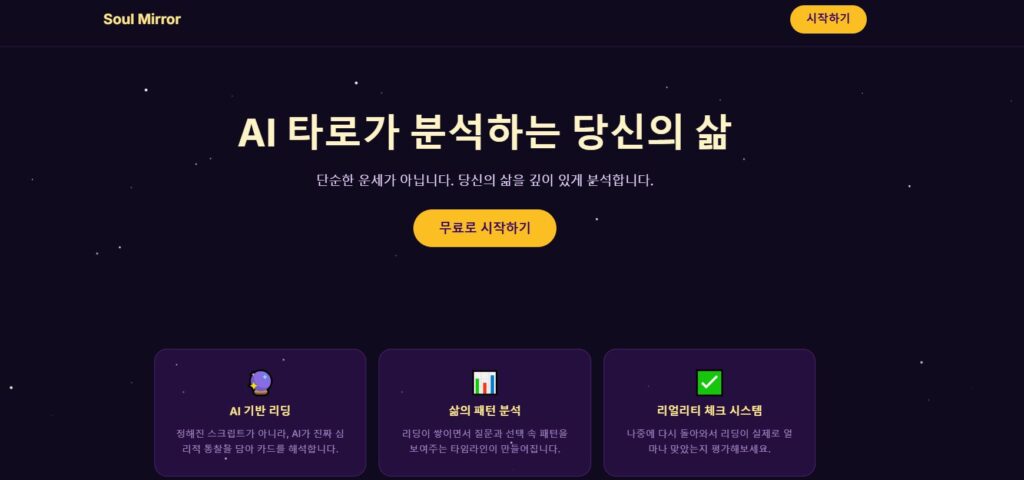
The platform would still use tarot cards as conversation starters. However, the real intelligence would come from AI identifying recurring emotional themes, communication habits, and personal growth opportunities over time. You can try the early version right now at soul-mirror-dun.vercel.app.
- AI Memory
- Reflection
- Journal
- Emotion Analysis
- Growth Tracking

Anthropic’s research on large language model alignment highlights that the most meaningful AI interactions occur when the model adapts to the user’s actual context rather than responding from a fixed template. That principle became the technical north star for Soul Mirror AI.
🚀 The First Product Vision
Instead of asking, “What card did you draw?” — I wanted the platform to ask, “What has been on your mind recently?” Instead of delivering a fixed answer, it would guide users through a thoughtful conversation. Tarot would become the beginning of the discussion, not the destination.
The mission became surprisingly simple. Build an AI that helps people understand themselves better — not an AI that claims to know their future.
That subtle but meaningful shift separated Soul Mirror AI from every other product I had tested. It also made the design constraints much clearer. If the goal is reflection rather than prediction, every feature should support slowing down — not speeding up.
🛠 Designing the First MVP
Once the concept became clear, I resisted the temptation to build everything at once. Like many developers, I had dozens of exciting feature ideas — daily journals, personality reports, voice conversations, community features, premium memberships. But adding everything immediately would only delay the launch. Instead, I asked a much simpler question.
“What is the smallest product that still delivers real value?”
That question became the guiding principle behind version one of Soul Mirror AI. The goal wasn’t perfection. It was creating an experience someone could genuinely enjoy within five minutes of visiting the website.
Every feature must solve one real problem. If it doesn’t improve the user’s experience, it can wait until a future version. Scope is a feature too.
- AI-powered tarot interpretation using context-aware prompts
- Three-card reading experience — clean, focused, no clutter
- Mobile-first responsive interface
- User authentication via Supabase
- Reading history saved per user session
- Personal reflection journal attached to each reading
- Emotion tracking dashboard (simple, not overwhelming)
- Fast page loading — target under 2 seconds on mobile
No marketplace. No social feed. No subscription billing system. No gamification. Scope creep is the #1 reason indie projects never ship. Keeping version one lean was a strategic choice, not a limitation.
⚙️ Choosing the Technology Stack
With the product direction finalized, it was time to choose the technologies. The challenge wasn’t finding the most powerful tools — it was finding tools that were fast, reliable, scalable, and inexpensive enough for an independent developer.
| Category | Selected Technology | Reason |
|---|---|---|
| Frontend | Next.js | Fast performance and SEO-friendly architecture |
| Styling | Tailwind CSS | Rapid UI development without fighting specificity |
| Database | Supabase | Authentication and database in one platform |
| AI Engine | Claude API (Anthropic) | Context-aware natural language and nuanced interpretation |
| Deployment | Vercel | Simple continuous deployment with zero config |
Instead of chasing the newest technology, I chose tools with strong documentation, active communities, and a proven production track record. Boring stacks ship faster than exciting ones.
🤖 Why Claude Code Became Part of the Workflow
Writing code manually wasn’t the only option anymore. Modern AI coding assistants — specifically Claude Code — made it possible to move much faster while still keeping full control over the project.
Instead of generating an entire application with one prompt, I treated AI as a collaborative development partner. Large tasks became smaller milestones. Complex systems became manageable modules. Reviewing and refining code became significantly easier. That workflow — plan first, prompt second — made the output dramatically more reliable.
Define One Feature at a Time
Never ask AI to build the whole app. Scope each prompt to a single, testable component.
Create a Detailed Implementation Plan
Write out exactly what the feature should do, what inputs it needs, and what output it should produce — before writing any prompt.
Generate Only the Required Component
Ask for one function, one API route, or one UI component at a time. Avoid monolithic outputs.
Review Every Output Manually
AI-generated code must be read, understood, and tested before it ships. Treat it like a junior developer’s PR, not a finished product.
Improve Through Iteration
The first pass is rarely the final version. Refine through targeted follow-up prompts rather than starting over.
Development Workflow
Planning before prompting — every time
According to OpenAI’s research on LLMs for code generation, models perform significantly better when given precise, scoped instructions compared to broad, open-ended prompts. That insight directly shaped how I use Claude Code throughout this project.
🗺 Development Roadmap
Breaking the project into weekly milestones made the workload feel realistic. Instead of worrying about hundreds of tasks, I only needed to focus on completing the next milestone. That mindset kept the project moving forward without becoming overwhelming.
A finished MVP is infinitely more valuable than a perfect idea that never launches. The real learning begins after users start interacting with your product — not after you’ve perfected every edge case in isolation.
“Building slowly with consistency beats planning forever.”
📈 Why This Project Feels Different
Most AI products compete by adding more features. I wanted to compete by creating a better experience. Soul Mirror AI isn’t designed to replace human intuition. Instead, it’s designed to help users slow down, reflect, and recognize patterns they may have overlooked. That subtle difference became the entire identity of the project.
- Build for people, not algorithms.
- Reflection is more valuable than prediction.
- Simple products launch faster — and improve faster.
- User feedback matters more than assumptions.
- Continuous improvement beats perfect planning.
❓ Frequently Asked Questions
Is Soul Mirror AI trying to predict the future?
No. The platform uses tarot cards as conversation starters, not as oracles. The goal is to encourage thoughtful self-reflection based on what the user is currently experiencing — not to deliver fixed predictions about what will happen next.
Why use AI instead of traditional tarot readers?
AI allows every conversation to become personalized and available around the clock. Instead of repeating generic card interpretations, responses can adapt to each user’s specific situation, emotional context, and history — something a static card book simply can’t do.
Why build an MVP before adding all the features?
Launching early allows real users to shape the product. Adding every possible feature before launch almost always delays progress, increases unnecessary complexity, and results in building things nobody actually wanted. The MVP proves the core concept first.
How does Soul Mirror AI protect user privacy during readings?
User data is stored per authenticated account using Supabase with row-level security enabled. Readings are private by default and never shared across users. No third-party advertising or analytics platforms have access to reading content.
Will Soul Mirror AI always be free to use?
The initial MVP launches with a generous free tier to gather real user feedback. A premium plan covering additional features like extended reading history, advanced emotion tracking, and priority AI responses is planned for a future version — but no timeline is confirmed yet.
🏁 Final Thoughts
Looking back, deciding to build Soul Mirror AI wasn’t really about tarot. It was about curiosity. It was about wondering whether artificial intelligence could create moments of genuine self-reflection instead of simply generating another automated answer.
Whether this project succeeds or evolves into something completely different, one thing is already certain. The most valuable part wasn’t the code. It was learning to ask better questions before writing it.
Sometimes the best products begin not with a brilliant feature — but with a simple observation that nobody else decided to explore.
Every meaningful project starts with a question worth asking.
This one started with: “Why do all these tarot websites feel exactly the same?”
The answer is live at soul-mirror-dun.vercel.app — and being built one week at a time.
“Every meaningful project starts with a question worth asking.”
➡️ What’s Next?
Planning was only the beginning. In Part 2 of this series, I’ll share how I built the first version of Soul Mirror AI using Claude Code — from setting up the project structure to creating the first AI-powered tarot reading experience.
📖 Continue Reading — Part 2: Building Soul Mirror AI with Claude Code
• Project Structure & File Organization
• AI Prompt Design for Tarot Interpretation
• Supabase Database & Auth Setup
• First Working Prototype Walkthrough
👉 Already curious? The live MVP is up at soul-mirror-dun.vercel.app — try a reading before Part 2 drops.
- ✔ Part 1 — Planning & Product Strategy (You are here)
- ➡ Part 2 — Building Soul Mirror AI with Claude Code
- ⏳ Part 3 — Launch, Users & What I’d Do Differently
- 🌐 Live Site — soul-mirror-dun.vercel.app