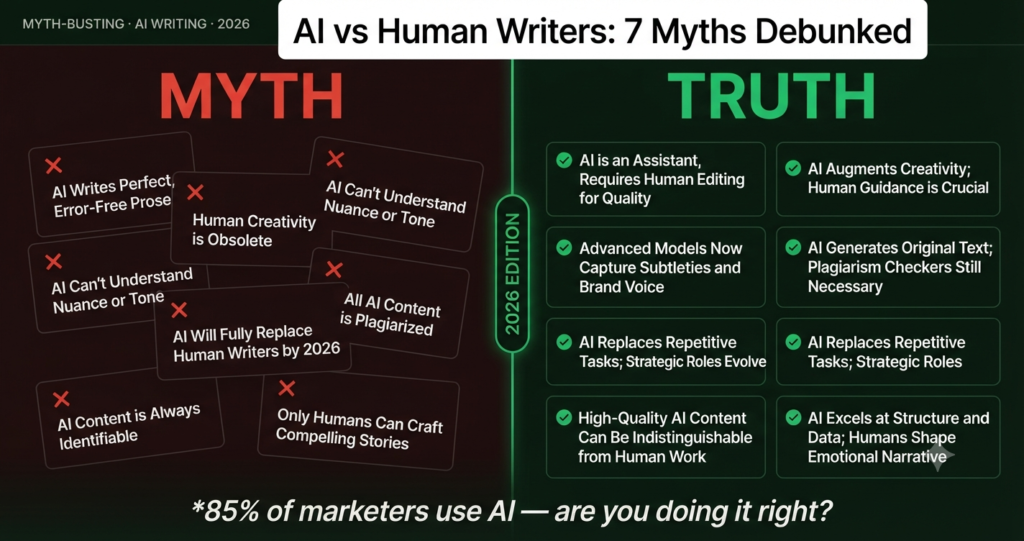
Your content strategy is probably built on at least three assumptions about AI writing that are either wrong, outdated, or only half-true. That’s a problem — because wrong assumptions lead to the wrong tool choices, wasted budget, and content that underperforms.

The AI writing debate has been going on since ChatGPT launched in late 2022. Four years later, it’s still producing more heat than light — because most of the arguments are based on myths that were questionable then and are flatly wrong now. Both sides are guilty: AI evangelists overpromise what the tools can do, while skeptics dismiss capabilities that have materially improved in the last 18 months.
What follows isn’t a “which is better” verdict. It’s a myth-by-myth breakdown of what’s actually true in 2026 — backed by real data, not vendor marketing or reflexive skepticism. By the end, you’ll know exactly where AI writing excels, where human writers still can’t be replaced, and what the most effective content teams are actually doing.
🚫 Myth #1: “AI Writing Will Replace Human Writers”
AI tools are so capable now that companies can fire their writers and generate all content automatically. Human writers are an expensive overhead that most businesses no longer need.
AI tools are replacing specific writing tasks — not writers. The teams reporting the highest content ROI in 2026 use AI to handle first drafts and structure, while human writers do strategy, voice, fact-checking, and the editorial decisions that make content worth reading.
The “replacement” narrative makes great headlines and terrible strategy. Here’s what the data actually shows: approximately 85% of marketers now use AI for content tasks — and those who do are 25% more likely to report success with their content campaigns. That’s not a replacement story. That’s an augmentation story. Writers who use AI are outperforming writers who don’t — which means the skill being devalued isn’t writing, it’s writing slowly.
The jobs that have genuinely shrunk are the ones that were already purely mechanical: spinning existing content, rewriting product descriptions for thin affiliate sites, generating filler blog posts at scale with no original research. Those tasks AI does handle cheaply. But according to Anthropic’s internal research teams, the most-used AI writing applications in professional settings are first-draft generation and structural outlining — both still requiring significant human refinement before publication.
💡 Key Insight
The question isn’t “will AI replace writers?” It’s “which writing tasks should a human own, and which should AI accelerate?” Teams that answer this correctly are producing 3× the content volume with the same headcount — not eliminating their writing teams.
🚫 Myth #2: “AI-Generated Content Gets Penalized by Google”
Google’s algorithms can reliably detect AI-written content and will demote or penalize pages that use it. Publishing AI content is an SEO risk that’s not worth taking.
Google has explicitly stated it doesn’t penalize AI content — it penalizes low-quality, unhelpful content regardless of how it was produced. Human-written spam gets penalized. High-quality AI-assisted content ranks. The detection argument is largely a myth.
Google’s own guidance, updated throughout 2025 and 2026, has been consistent on this point: Google does not treat automation as the problem — the real issue is low-quality content created only to manipulate rankings. A well-researched, genuinely helpful article produced with AI assistance will rank. A 500-word human-written article stuffed with keywords won’t. The quality bar is the same regardless of how the content was created.
What does affect SEO is the quality of the output. Multiple 2024–2026 case studies show AI-assisted, human-optimized articles maintaining or improving rankings after core updates, while thin, unedited AI content lost visibility. The pattern is clear: AI generates the structure and coverage; humans add the specificity, original examples, and editorial judgment that makes content worth ranking. The process matters less than the result.
⚠️ Real Risk
The actual SEO risk from AI isn’t Google detection — it’s publishing unedited drafts. Raw AI output often contains factual errors, outdated pricing, hallucinated statistics, and generic phrasing that reads as thin content. The risk isn’t that Google knows AI wrote it. The risk is that unedited AI content is genuinely low quality.
🚫 Myth #3: “AI Writing Is Just as Good as a Professional Writer”
GPT-4o and Claude Sonnet 4 write so well that a professional writer can’t produce meaningfully better content. The quality gap is negligible — so why pay a writer?
AI writing quality has improved dramatically — but specific gaps remain significant. Original research, genuine expertise, lived experience, investigative reporting, and content requiring real relationships or access are still firmly in human territory. The “just as good” claim depends entirely on the content type.
Let’s be specific about where the gaps actually are in 2026, because “AI writing quality” is not a single thing. For producing a structured blog post explaining an established concept? AI is extremely capable. For writing a product review based on real hands-on testing? AI cannot do this — it can synthesize existing reviews, but it has no direct experience. For investigative journalism requiring source relationships and unreleased information? Entirely beyond AI’s current capability.
The nuanced version: human writers have skills AI cannot yet replicate, including creativity and emotional intelligence — the ability to create original, compelling content that appeals to emotions and imagination. Where AI falls shortest isn’t grammar or structure. It’s the original insight, the unexpected angle, the reference to something that happened last Tuesday that changes the whole framing of a topic. AI is a very capable generalist. It’s not a domain expert with a decade of specific experience.
🚫 Myth #4: “AI Content Always Sounds Robotic and Generic”
AI writing has a distinctive robotic, generic quality that readers immediately notice. “AI-isms” like “In today’s world” and “It’s important to note” are dead giveaways, and the content always feels soulless.
This was largely true in 2022–2023. It’s increasingly false in 2026. With proper prompting, style instructions, and a human editing pass, AI output is now regularly indistinguishable from competent professional writing. The “robotic” tell is a prompting failure, not a model limitation.
The “AI sounds robotic” critique is outdated in the same way that “digital cameras look worse than film” became outdated — true once, not anymore. Claude Sonnet 4 and GPT-4o, when given specific role instructions, tone examples, and format constraints, produce prose that passes blind reading tests with professional editors. The problem isn’t the model’s capability. It’s that most people type “write a blog post about X” and then judge the result against a professionally-crafted, well-edited article.
That’s not a fair comparison. A human writer who spent 30 seconds on a brief would also produce generic, forgettable content. AI quality is almost entirely a function of how well you direct it. According to Anthropic’s prompt engineering documentation, models like Claude respond dramatically better to explicit style instructions, voice samples, and constraint-based prompting than to vague open-ended requests. The “robotic” output is usually a prompting problem.
💡 Pro Tip
Paste 2–3 paragraphs of your own best writing into your AI prompt as a style reference before asking it to draft anything. The difference in output quality is immediate and significant. The model doesn’t write in your voice by default — you have to show it what your voice looks like.
📋 Recap So Far — What’s Actually True in 2026
- ✅ AI is replacing writing tasks, not writers — augmentation beats replacement
- ✅ Google penalizes low-quality content, not AI content — quality is the bar
- ✅ AI matches human quality on some content types, falls short on others
- ✅ “Robotic” AI writing is a prompting failure, not a model ceiling
- ⬇️ Three more myths to debunk below — including the most expensive one
🚫 Myth #5: “Human Writers Are Always More Accurate”
AI hallucinations make it fundamentally unreliable for factual content. Human writers research properly and verify their claims, so human-written content is inherently more accurate than AI-generated content.
Human writers make factual errors too — and those errors often go unchecked because the content “feels” authoritative. AI hallucination rates have dropped significantly in frontier models and are now lower on many task types than the error rate in content from non-expert human writers working fast under deadline pressure.
Hallucination is a real limitation of AI writing — but it’s being discussed as though human writing is a gold standard of accuracy, which it isn’t. Any editor who’s worked with freelance writers at scale knows that factual errors, misquoted statistics, and outdated information are common in human-produced content too. The difference is that AI hallucinations are harder to spot because the writing around them sounds confident and fluent.
The practical solution isn’t to avoid AI for factual content — it’s to build verification into the workflow. For any article containing statistics, pricing data, or expert quotes, the human editor’s job is to verify every specific claim before publishing. That’s a good editorial practice regardless of whether AI was involved. The smarter framing: AI is a first-draft tool, not a fact-publishing machine. Treat its factual outputs like you’d treat a smart intern’s research — useful starting point, requires verification.
🚫 Myth #6: “Using AI for Writing Is Cheating or Dishonest”
Publishing content that used AI assistance is dishonest — readers are being deceived into thinking a human wrote it. Ethical content creators should disclose AI use or avoid it entirely.
Writers have always used tools that accelerate production — spell checkers, grammar tools, research databases, ghostwriters, editorial assistants. AI is a more powerful version of tools that have existed for decades. The ethical question isn’t “did you use a tool?” — it’s “is the content accurate, original in its perspective, and genuinely useful?”
This myth is particularly interesting because it applies a standard to AI that we don’t apply to any other writing tool. Nobody accuses a journalist of “cheating” for using Grammarly, or a novelist of being “dishonest” for using a developmental editor who substantially restructures their manuscript. The concern about AI specifically tends to collapse on examination: if the ideas are yours, the research is accurate, the voice is authentically shaped by human editing, and the content genuinely serves the reader — it’s good content, full stop.
Where ethical concerns are real: claiming AI-generated content as original journalism when you haven’t verified the facts, using AI to fabricate quotes or research, or flooding search results with thin AI content designed purely to capture clicks. Those are problems of intent and quality — not problems of using AI as a tool in a responsible editorial workflow.
🚫 Myth #7: “The Best Strategy Is All-AI or All-Human”
You’re either a team that uses AI for writing or you’re not. Mixing AI and human writing creates inconsistency and confusing workflows. Pick one approach and commit to it.
The hybrid model — AI for first drafts, research, structure, and variation; humans for strategy, voice, fact-checking, and editorial judgment — consistently outperforms either pure approach on quality AND volume. The false binary is the most expensive mistake in content strategy right now.
Many content teams report that the hybrid approach allows them to triple their output while actually improving quality scores — because human editors can dedicate full attention to strategic refinement rather than basic composition. When you start from a solid AI-generated draft, your writer’s time goes toward the 30% of work that actually differentiates content: the specific examples, the sharp opening hook, the original angle, the brand-aligned voice. That’s a fundamentally different job — and most writers find it more satisfying, not less.
Smart content operations in 2026 match each piece to the right resource based on strategic value, required expertise, and production constraints. High-volume, SEO-focused content with moderate strategic importance fits AI generation as a foundation. Low-volume, high-stakes content requiring deep expertise — thought leadership, technical deep-dives, investigative pieces — demands more human ownership. Everything in between benefits from hybrid workflows.
📊 Where AI Wins, Where Humans Win, Where Hybrid Wins
| Content Type | AI Alone | Human Alone | Hybrid | Best Approach |
|---|---|---|---|---|
| SEO blog posts | Good structure, generic voice | Strong voice, slow output | Strong voice + fast output | HYBRID |
| Product descriptions (bulk) | Fast, consistent, scalable | Slow, inconsistent at scale | Overkill for most cases | AI |
| Investigative journalism | Cannot do this | Full ownership required | AI for research synthesis only | HUMAN |
| Email campaigns | Good for volume/variants | Better for high-stakes sends | AI drafts, human refines | HYBRID |
| Thought leadership | Generic, no original POV | Authentic expertise | AI structures, human owns POV | HUMAN |
| Social media captions | Excellent for volume | Better single-piece quality | AI generates, human selects | AI |
| Technical documentation | Good structure, needs verification | Accurate but slow | AI drafts, SME reviews | HYBRID |
| Hands-on product reviews | Cannot do this | Full ownership required | AI for comparison context only | HUMAN |
✅ What the Best Content Teams Are Actually Doing
After stripping away the myths, the picture of what high-performing content operations look like in 2026 is surprisingly consistent. It’s not dramatic. It’s disciplined.
- AI generates first drafts from detailed briefs — not open-ended prompts. The brief specifies target keyword, intended audience, key arguments, and 2–3 sources to reference.
- Human editors own the opening hook, the specific examples, and any claim that requires verification — every time, no exceptions.
- Brand voice is encoded in a system prompt or style guide that’s applied to every AI-assisted piece — not left to interpretation.
- Factual claims (statistics, pricing, expert quotes) are verified against primary sources before publishing. AI output is treated as a starting point for research, not a finished citation.
- Content strategy — what to write, for whom, and why — remains a human function. AI executes the brief; it doesn’t set the editorial calendar.
- Output quality is measured continuously: rankings, time-on-page, conversion rates. Teams adjust their AI-to-human ratio based on what the data shows, not on ideology.
According to Ann Handley, Chief Content Officer at MarketingProfs, the most important shift in content strategy isn’t the tools — it’s understanding that the editorial judgment layer has become more valuable, not less, as AI handles more of the mechanical production work. The writers who thrive in 2026 aren’t the ones who resist AI or blindly adopt it — they’re the ones who know exactly which decisions belong to them.
❓ Frequently Asked Questions
Should I disclose when I use AI to write content?
Disclosure norms vary by context. For journalism and academic writing, disclosure is increasingly expected and ethically appropriate. For marketing content, blog posts, and business writing, there’s no established standard requiring disclosure as of 2026 — and Google explicitly doesn’t require it for ranking purposes. The practical standard that’s emerging: disclose when the AI’s lack of lived experience or verified expertise is material to how the reader should weight the content. A product review based on AI synthesis of other reviews is different from a review based on actual testing — and readers deserve to know that distinction.
How much editing does AI content actually need before publishing?
More than most people plan for, less than skeptics claim. A well-prompted AI draft on a topic the writer knows well typically needs 20–40% revision to reach publication quality — catching factual errors, sharpening the opening, injecting specific examples, and calibrating tone. A poorly prompted draft on an unfamiliar topic might need 70%+ revision and is often faster to write from scratch. The ROI depends heavily on how well you brief the AI before it writes, not just how you edit after.
Can AI writing rank on Google in 2026?
Yes — when it meets Google’s quality standards. Google’s Helpful Content guidelines evaluate E-E-A-T (Experience, Expertise, Authoritativeness, Trustworthiness) regardless of how content was produced. AI-assisted content that’s accurate, specific, well-sourced, and genuinely useful ranks. AI content that’s thin, generic, or factually unreliable gets filtered out — the same as human-written content with those same problems. The production method isn’t the ranking signal; quality is.
Which AI tool is best for content writing in 2026?
For long-form writing where voice and naturalness matter, Claude (Anthropic) is the most consistently recommended tool among professional writers in 2026. For high-volume short-form content and integrated image generation, ChatGPT (OpenAI) offers the broadest feature set. For content teams who want AI writing built into a scheduling and publishing workflow, tools like Jasper AI and Buffer AI Assistant are purpose-built for that use case. The best choice depends on your primary use case — there’s no single universal winner.
Is it worth hiring a human writer if you can use AI?
For high-stakes content that requires genuine expertise, original research, investigative access, or deep brand voice ownership — yes, human writers are worth the investment and AI can’t adequately substitute. For high-volume content where speed and coverage matter more than singular voice — AI-assisted workflows with human editing oversight deliver better ROI than pure human production. The decision framework: if the content requires something AI genuinely can’t provide (real experience, sourced expertise, investigative access), pay for a human writer. If AI can produce a solid 70% draft, build a hybrid workflow instead.
🏁 The Bottom Line
The AI vs human writing debate in 2026 is mostly a false one — sustained by people who benefit from either extreme position. AI tool vendors oversell capability. Writers’ advocacy organizations oversell irreplaceability. Neither is telling you the full, honest picture.
The full picture: AI writing has improved dramatically and handles a wider range of content types competently than most people realize. Human writing retains clear advantages in domains requiring original expertise, verified experience, and genuine creative originality. The gap between those two categories is much smaller for some content types and much larger for others — and the smartest content teams in 2026 know exactly where that line sits for their specific use case.
Stop asking “AI or human?” Start asking: “Which parts of this content piece genuinely require human judgment, and which parts would benefit from AI acceleration?” Answer that question for your specific content mix, build a workflow around the answer, and measure the results. That’s the approach that’s actually working in 2026 — and it’s not complicated once you drop the mythology.
Which of these myths was most surprising to you — or which one do you still disagree with? Leave a comment below.