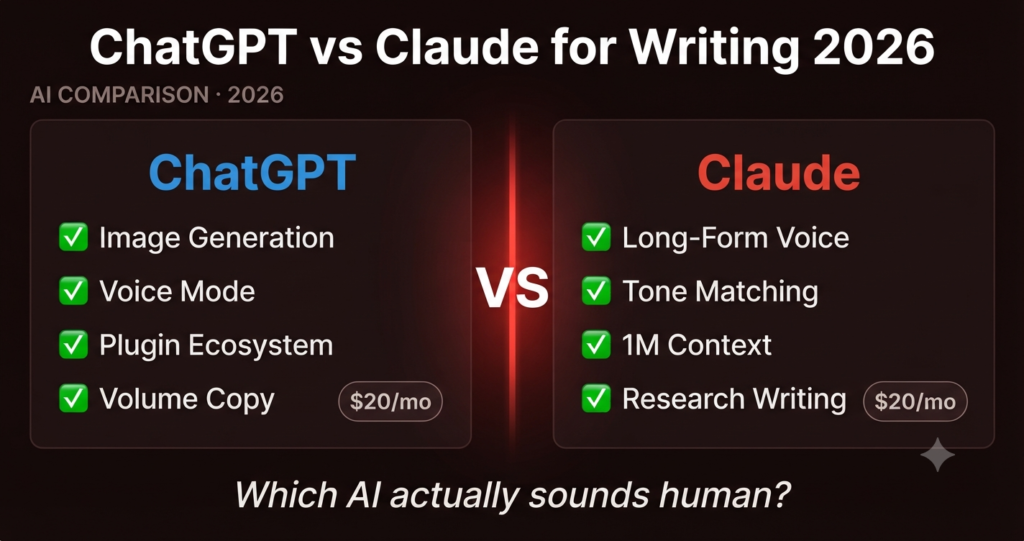
Most “ChatGPT vs Claude” comparisons declare a winner and move on. The honest answer is messier — and more useful.

“One drafted a blog post I barely had to edit. The other planned a full product launch while generating images for it. They’re not competing — they’re different tools wearing the same price tag.”
📋 What This Comparison Covers
- ✍️ Long-form writing quality — blog posts, essays, reports
- 📣 Short-form copy — emails, social posts, ad headlines
- 🎨 Tone calibration — how well each follows voice instructions
- 🧠 Reasoning in writing — arguments, analysis, nuanced takes
- ⚙️ Features that matter for writers — memory, images, context window
- 💰 Pricing at every tier — $20/month to $200/month
- 🎯 “Which One Is Right for You?” — decision matrix by use case
Everyone keeps asking which AI is better. The honest answer, after using both every day for the past year: it depends so specifically on what you’re writing that the question is almost the wrong one. ChatGPT and Claude aren’t competing for the same crown. They’ve evolved into genuinely different tools — one built for depth and voice, one built for range and integration.
What follows is a category-by-category breakdown based on real writing tasks — not benchmarks, not press releases. If you write for a living, this is the comparison you’ve been looking for.
✍️ Long-Form Writing: Blog Posts, Essays, Reports
This is the category where the gap between the two models is most visible — and most consistently reported by working writers.
Claude produces prose that reads closer to a finished draft. Transitions are smoother. Sentences vary in length naturally. It doesn’t open paragraphs the same way twice. Ask it to write a 1,000-word blog post in a conversational tone, and the result typically needs light editing rather than restructuring. Claude follows complex style instructions — “write like you’re explaining this to a smart friend who has 10 minutes, not a textbook” — with a precision that GPT-4o-level ChatGPT consistently missed and that current ChatGPT has only partially closed.
ChatGPT writes clearly and competently. It covers topics thoroughly and follows formatting instructions well. But it has predictable habits: it tends to open with a thesis paragraph that summarizes everything before diving in, uses transition phrases liberally (“Furthermore,” “Additionally,” “It’s worth noting that”), and defaults to a comprehensive-but-generic coverage style. The result reads like a clean, well-organized first draft — useful, but requiring more editorial intervention to sound like a specific human wrote it.
⚠️ Three filler sentences despite the instruction. Opens with a broad statement, not a hook.
✅ Immediate hook. No preamble. Reads like a person wrote it.
Verdict for long-form writing: Claude. Multiple independent reviews in 2026 — including Emergent’s month-long head-to-head test — consistently find Claude’s drafts closer to publication-ready. For anything over 500 words where voice matters, Claude is the stronger daily driver.
📣 Short-Form Copy: Emails, Social Posts, Ad Headlines
Short-form is more contested — and this is where ChatGPT’s strengths start showing up.
For high-volume, templated short-form content — 10 subject line variations, 5 Instagram caption options, a batch of LinkedIn hooks — ChatGPT is faster and more comfortable generating quantity. It handles variation requests well and produces structured outputs quickly. If you need 20 options to pick from, ChatGPT delivers 20 usable options. Claude delivers 5 great ones and starts getting repetitive.
For single-piece short-form where quality matters more than volume — one cold email that has to land, one headline for a campaign — Claude’s tone calibration tends to win. It reads the room better. Ask both models to write a sales email that “doesn’t sound salesy,” and Claude is more likely to pull off the instruction while ChatGPT more frequently slips back into marketing cadences.
💡 Pro Tip
For short-form copy workflows: use ChatGPT to generate volume (10–20 options), then run your top 3 through Claude for refinement and tone-polish. The combination beats either tool used alone for most content marketing use cases.
🎨 Tone Calibration: Following Your Voice Instructions
This is the most underrated differentiator between the two — and the one that matters most to writers who have a distinct voice they’re trying to preserve.
Claude follows tone instructions with unusual precision. “Write this like David Sedaris wrote it after reading a McKinsey report” will produce something genuinely weird and interesting. “Match the tone of this sample: [paste your own writing]” produces output that’s often indistinguishable from your actual voice on the first try. According to SurePrompts’ 2026 comparison, Claude wins decisively for natural writing voice — the quality that most professional writers rank as their top priority in an AI writing tool.
ChatGPT has improved significantly on this dimension in 2026. GPT-4o is more adaptable with structured content and handles explicit format instructions reliably. But it still has a “house style” that bleeds through on longer pieces — a competent, slightly formal register that takes deliberate effort to dial out.
🧠 Reasoning in Writing: Arguments, Analysis, Nuanced Takes
Some of the most valuable writing isn’t creative — it’s analytical. Board memos, strategic recommendations, essays that actually take a position. This is where the models’ underlying reasoning capabilities show up in writing quality.
Claude handles nuance better. Ask it to write a persuasive essay arguing a position it might “disagree with,” and it produces a genuinely well-structured argument without hedging every other sentence. Ask it to analyze a business situation and make a recommendation, and it reasons through the tradeoffs before landing. The 200K-to-1M token context window is also a practical writing advantage — Claude can hold an entire document in working memory and maintain consistency across a 10,000-word piece without losing track of earlier sections.
ChatGPT’s reasoning has improved substantially in 2026, particularly with GPT-4o’s extended thinking modes. For analytical writing tasks, the gap is smaller than it was 18 months ago. Where ChatGPT still falls slightly behind: writing that requires genuine intellectual commitment to a position rather than balanced coverage of “both sides.”
⚙️ Features That Matter for Writers
| Feature | ChatGPT | Claude | Winner |
|---|---|---|---|
| Image generation | ✅ Native (GPT-4o) | ❌ Not available | ChatGPT WIN |
| Context window | 128K tokens | 200K–1M tokens | Claude WIN |
| Voice mode | ✅ Advanced Voice Mode | ❌ Not available | ChatGPT WIN |
| Web browsing | ✅ Native search | ✅ Web search (tool) | Tie TIE |
| Persistent memory | ✅ Automatic across chats | ✅ Claude Projects | Tie TIE |
| Long-doc analysis | ✓ Good (128K limit) | ✅ Excellent (1M window) | Claude WIN |
| Tone following | ✓ Good | ✅ Excellent | Claude WIN |
| Plugin/GPT ecosystem | ✅ Massive (Custom GPTs) | ✓ Growing | ChatGPT WIN |
| Privacy defaults | ✓ Opt-out training | ✅ Stronger defaults | Claude WIN |
⚠️ Important for Writers
Claude cannot generate images as of July 2026. If your writing workflow includes creating featured images, social graphics, or visual assets alongside written content, you’ll need ChatGPT or a separate image tool like Midjourney or Adobe Firefly. This is the single biggest practical limitation for content creators who want one tool for everything.
💰 Pricing: What You Actually Get at Each Tier
| Tier | ChatGPT | Claude | Best For |
|---|---|---|---|
| Free | GPT-4o (limited) | Claude Sonnet (limited) | Occasional casual use |
| $20/month | ChatGPT Plus — GPT-4o, image gen, voice | Claude Pro — Sonnet 4.6, Projects, extended context | Most writers stop here |
| $100/month | ChatGPT Pro — unlimited GPT-4o + o3 | Claude Max — 5× more usage + Opus 4.6 access | Daily heavy users |
| $200/month | ChatGPT Pro (alt tier) | Claude Max (alt tier) | Teams / agencies |
The $20 tier is where almost every individual writer lands, and both tools deliver strong value there. The pricing divergence that matters is at the top: as of July 2026, Claude Max costs $100/month while ChatGPT Pro runs $200/month — a 2× gap at the power user tier that meaningfully changes the ROI calculation for high-volume professional writers.
🎯 Which One Is Right for You?
Decision Matrix — Pick by Your Primary Use Case
ChatGPT — Best For
Range, Integration & Volume
- Image generation alongside writing
- Voice mode for hands-free drafting
- High-volume short-form content
- Microsoft / enterprise ecosystems
- One-tool-for-everything workflows
Claude — Best For
Voice, Depth & Long-Form
- Blog posts and essays that sound human
- Precise tone matching to your style
- Long-document analysis (1M context)
- Nuanced analytical writing
- Cost-effective at power user tier
❓ Frequently Asked Questions
Is Claude or ChatGPT better for writing in 2026?
For long-form writing where voice and naturalness matter, Claude is the stronger choice in 2026. Multiple independent head-to-head tests find Claude’s prose closer to publication-ready, with better tone calibration and fewer “AI-isms.” For short-form volume, mixed media content, or workflows that require image generation, ChatGPT is the more complete tool. Both cost $20/month at the standard tier, so the answer depends entirely on your primary use case.
Can Claude generate images for my articles?
No. As of July 2026, Claude does not have native image generation capability. Claude can analyze and describe uploaded images, but it cannot create them. If your writing workflow includes generating featured images or visual assets, you’ll need ChatGPT (which includes image generation via GPT-4o), or a dedicated tool like Midjourney, Adobe Firefly, or Flux.
Does ChatGPT or Claude remember my writing style between sessions?
Both have memory features, but they work differently. ChatGPT’s persistent memory is automatic — it stores details about you across all conversations without extra setup. Claude uses Projects, where you define a system prompt that applies to every conversation in that project. For writers, Claude Projects is arguably more controllable — you explicitly encode your voice, audience, and style rather than hoping the model extracts them automatically from conversation history.
Which is better for writing academic or research papers?
Claude edges ahead for academic and research writing, primarily because of its larger context window (up to 1M tokens) and stronger performance on nuanced, analytical prose. Claude can hold an entire paper draft in working memory and maintain consistency across sections — something that becomes a practical limitation with ChatGPT’s 128K window on longer documents. Claude also scores higher on benchmark tests for PhD-level reasoning (91.3% on GPQA Diamond), which translates to better performance on complex academic content.
Should I subscribe to both ChatGPT and Claude?
Many professional writers do — at $20/month each, the combined $40/month is justified if writing is a significant part of your work. The practical workflow: use Claude as your primary writing tool for anything where quality and voice matter, and ChatGPT for image generation, voice mode, and high-volume drafting. If you can only pick one, your primary use case should decide: long-form depth points to Claude, everything-in-one points to ChatGPT.
🏁 The Bottom Line
The “which is better” framing misses the point in 2026. ChatGPT and Claude have diverged into genuinely different tools. One is a Swiss Army knife with remarkable range. The other is a surgical instrument for language.
If your primary work is producing written content — blog posts, newsletters, reports, proposals, any piece where your specific voice matters — Claude is the tool that will save you more editing time. That’s the consistent verdict from writers who’ve used both seriously.
If you need images, voice mode, web research, code execution, and writing all in one interface without switching apps, ChatGPT’s ecosystem is genuinely impressive and the $20/month is well justified.
The best writers in 2026 aren’t loyal to one tool. They know exactly which task goes to which model — and switch without thinking twice. That clarity is worth more than any single subscription decision.
Which are you using for your writing workflow right now — and what’s working? Leave a comment below.